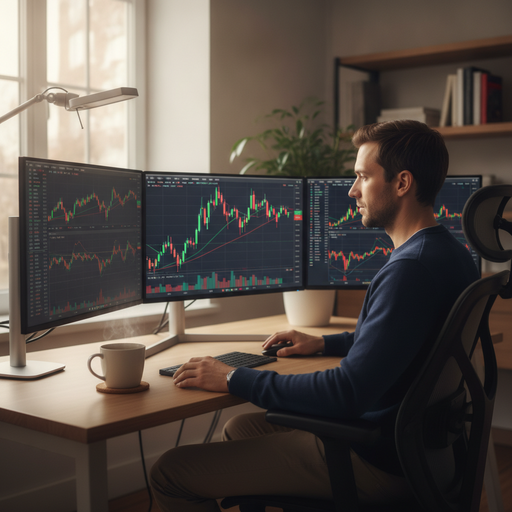

The Day I Stopped Gambling and Started Trading
Imagine this: You are sitting in front of your laptop, heart racing, watching a flickering red candle on a stock chart. You just “invested” a significant portion of your savings into a tech company because a popular influencer on social media said it was going to the moon. Ten minutes later, your screen is a sea of crimson, and you’ve lost the equivalent of a month’s rent. You feel sick, confused, and defeated.
This is the story of thousands of aspiring investors. I know it well because it was my story, too. For years, I treated the stock market like a high-stakes casino. I chased “hot tips,” bought into the hype of “get-rich-quick” schemes, and lacked a fundamental understanding of why prices move. It wasn’t until I sat down and treated trading as a profession—investing in a comprehensive stock trading course—that the fog finally cleared. If you want to survive the volatility of Wall Street, you don’t need luck; you need an education.
The Hidden Danger of Being “Self-Taught”
In the age of YouTube and TikTok, it is easy to believe that you can learn everything for free. While there is a wealth of information available, it is often fragmented, contradictory, and lacking in context. A begier might learn what a “bull market” is from one video and how to read a “candlestick” from another, but they rarely learn how these pieces fit together into a cohesive strategy.
A professional stock trading course provides the one thing free content lacks: a structured roadmap. When you are self-taught, you don’t know what you don’t know. You might master technical indicators but completely ignore the psychological aspect of trading. You might understand company earnings but have zero clue about risk management. A course bridges these gaps, ensuring you don’t step onto a landmine you didn’t even know existed.
Decoding the Language of the Market
To the untrained eye, a stock chart looks like a random heartbeat monitor. However, to a trained trader, those lines and bars tell a story of human emotion—fear, greed, and indecision. A quality trading course teaches you how to read this language through two primary lenses:
1. Technical Analysis
This is the study of price action and patterns. In a structured course, you learn more than just “buy low, sell high.” You dive into support and resistance levels, moving averages, and momentum oscillators like the RSI. More importantly, you learn how to identify high-probability setups rather than chasing every movement.
2. Fundamental Analysis
While technicals tell you “when” to buy, fundamentals tell you “what” to buy. You’ll learn how to read a balance sheet, understand Price-to-Earnings (P/E) ratios, and evaluate a company’s competitive moat. Understanding the health of a company gives you the conviction to hold a position when the market gets shaky.
The Lessoo One Mentions: Trading Psychology
Most begiers think trading is 90% strategy and 10% execution. In reality, it is the other way around. You can have the most sophisticated trading algorithm in the world, but if you panic and sell the moment the price drops 2%, or if you get greedy and refuse to take profits, you will fail.
A top-tier stock trading course dedicates significant time to the “ier game.” You learn about cognitive biases—like the Sunk Cost Fallacy or FOMO (Fear of Missing Out)—and how they sabotage your bank account. By practicing disciplined trading through simulated environments or “paper trading,” courses help you build the emotional callousness required to make rational decisions under pressure.
Risk Management: Protecting Your Capital
If you take away only one thing from a professional course, let it be this: Risk Management. Professional traders are not people who take big risks; they are people who manage risks effectively. A course will teach you the “1% Rule”—never risking more than 1% of your total account on a single trade.
Through lessons on stop-loss orders and position sizing, you learn how to stay in the game even after a series of losses. The goal of trading isn’t to be right 100% of the time; it’s to make sure that your wins are significantly larger than your losses. Without a course to teach you this mathematical discipline, you are essentially walking a tightrope without a safety net.
How to Choose the Right Stock Trading Course
With so many “gurus” promising overnight millions, how do you find a course that actually delivers value? Here are a few things to look for:
- Transparency: Does the instructor show their own trading results? Are they honest about the risks involved?
- Community Support: The best courses offer access to a community or discord where you can discuss trades with mentors and peers. Trading can be a lonely profession; having a support system is vital.
- Practical Application: Avoid courses that are purely theoretical. Look for programs that include live trading sessions or case studies of real-market scenarios.
- Longevity: Avoid “flash-in-the-pan” strategies. Look for courses that teach timeless principles of supply and demand rather than the latest “meme stock” trend.
The Shift from Hobbyist to Professional
When I finally finished my first comprehensive trading course, I didn’t suddenly become a millionaire overnight. But something more important happened: I became calm. I no longer felt the need to check my phone every five minutes. I had a plan for when to enter, a plan for when to exit, and a plan for what to do if I was wrong.
Trading transitioned from a stressful hobby into a structured business. I began to see losses not as failures, but as the “cost of doing business,” much like a restaurant owner views the cost of ingredients. This shift in perspective is the true value of professional education.
Conclusion: Your Future Self Will Thank You
The stock market is perhaps the greatest wealth-building tool ever created, but it is also a place where the uninformed hand over their money to the educated. You can choose to learn through expensive mistakes, losing thousands of dollars to “market tuition,” or you can choose to invest a fraction of that amount into a professional stock trading course.
Education provides the clarity, discipline, and strategy needed to navigate the chaotic waters of global finance. Don’t leave your financial future to chance. Take the time to learn the craft, master your emotions, and turn the stock market into a source of consistent opportunity. The best time to start was yesterday; the second best time is today.