From Gamer to Creator: How the Right Game Development Course Can Turn Your Dreams into Reality

The Spark of Creation
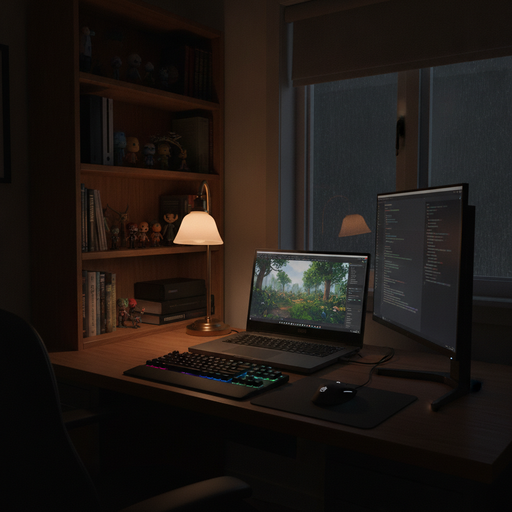
Imagine sitting in a dimly lit room, the glow of a monitor reflecting in your eyes. You’ve just finished an epic quest in your favorite RPG, or perhaps you’ve finally beaten that “impossible” boss in a platformer. But instead of putting the controller down, you find yourself staring at the credits, wondering: “How did they do that? How did they make me feel this way?”
That moment of curiosity is the first step in a journey from being a consumer to becoming a creator. For many, the world of game development feels like a fortress with high walls—guarded by complex mathematics, intimidating lines of code, and expensive software. However, the truth is that the drawbridge is down, and the gates are wide open. All you need is the right map, and in the world of digital creation, that map is a high-quality game development course.
The Call to Adventure: Why Choose a Structured Course?
In the age of information, you might wonder if you really need a formal course. After all, YouTube is overflowing with tutorials on everything from “How to make a jump script” to “Advanced shader programming.” While these resources are fantastic for solving specific problems, they often lack the one thing a begier needs most: a cohesive path.
Think of learning game development like building a skyscraper. If you just start grabbing bricks and mortar without a blueprint, you might get a few feet off the ground before the whole thing topples over. A structured game development course provides that blueprint. It teaches you the “why” behind the “how,” ensuring that you aren’t just copying code from a screen, but actually understanding the logic that powers the virtual worlds you inhabit.
Choosing Your Engine: Unity, Unreal, or the Unknown?
Every hero needs a weapon, and in game development, your weapon is your game engine. Most courses focus on one of the “Big Two,” and choosing between them is often the first major decision you’ll make.
The Unity Path
Unity is often the darling of the indie game world. It’s versatile, relatively easy to pick up, and uses C#, a language that strikes a perfect balance between power and readability. If you dream of making the next Hollow Knight or Among Us, a Unity-focused course is likely your best bet. These courses usually start with the basics of 2D physics before moving into the complexities of 3D environments and mobile optimization.
The Unreal Engine Path
If your heart beats for high-fidelity graphics and cinematic experiences, Unreal Engine is your destination. Used to create titles like Fortnite and The Witcher 4, Unreal is a powerhouse. Courses here often focus on C++ and the revolutionary “Blueprints” visual scripting system, which allows you to “code” by coecting nodes visually. It’s a steeper learning curve, but the results can be breathtakingly professional right out of the box.
The Anatomy of a Great Game Development Course
Not all courses are created equal. When you’re scaing the horizon for the right one, look for these key pillars of education:
- Project-Based Learning: Avoid courses that are 90% theory. You want a curriculum that asks you to build a small project in every module—a simple pong clone, a basic shooter, or a narrative-driven walking simulator.
- The Full Pipeline: Game development isn’t just coding. A comprehensive course should touch on game design (how to make things fun), level design (how to guide the player), and sound implementation.
- Community Support: Coding is a social activity, even if it doesn’t look like it. Look for courses that offer access to a Discord server or a forum where you can ask for help when your character starts spiing uncontrollably for no apparent reason.
- Portfolio Building: By the end of the course, you shouldn’t just have a certificate; you should have a portfolio of finished mini-games to show off to potential employers or collaborators.
The “Boss Fights”: Overcoming the Learning Curve
Let’s be honest: learning to make games is hard. There will be days when you stare at a screen full of red error messages and feel like giving up. This is what we call the “Mid-Level Slump.” A good course anticipates these frustrations. It teaches you how to debug, how to read documentation, and most importantly, how to break big problems into small, manageable pieces.
In a storytelling sense, these errors are the monsters in your path. Each time you solve a bug, you gain experience points. Eventually, what used to take you three hours to figure out will take you three seconds. That feeling of mastery is the ultimate “Level Up.”
From Student to Developer: The Final Quest
Once you’ve completed your course, you’ve reached the end of the tutorial, but the game is just begiing. The world of game development is vast. You might find that you love writing the logic for AI enemies, or perhaps you discover a passion for environment art—placing every tree and rock to tell a story through the scenery.
The beauty of a modern game development course is that it prepares you for the “Game Jam” culture. These are events where developers try to make a game from scratch in 48 or 72 hours. With the skills gained from a structured course, you can jump into these communities, collaborate with others, and start making a name for yourself in the industry.
Conclusion: The Controller is in Your Hands
We live in a golden age of digital creativity. Never before have the tools of the trade been so accessible to everyone with a computer and a dream. A game development course is more than just a set of lessons; it’s an investment in your own imagination. It’s the difference between saying “I wish this game existed” and saying “I made this game exist.”
So, take the leap. Choose your engine, find your mentor, and start your journey. The world is waiting to play the stories only you can tell. Your adventure begins with the first lesson. Are you ready to press Start?